
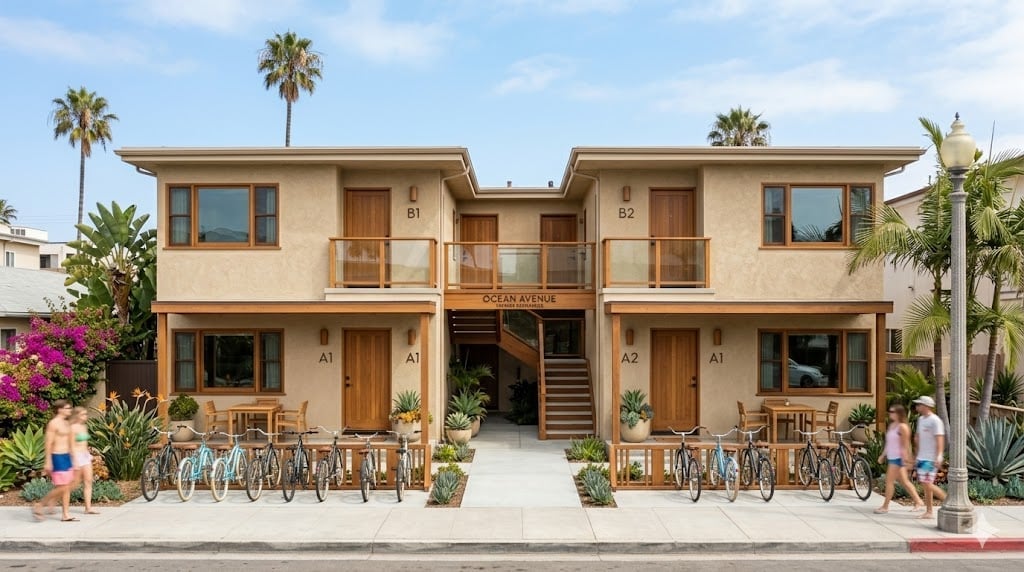
If you own an apartment building in Los Angeles right now, your insurance premiums have likely increased dramatically over the last few years — and if your policy has not already been non-renewed, there is a good chance it eventually will be.
After 40 years selling Los Angeles real estate and working with apartment owners across the Westside, I can honestly say I have never seen anything like what is happening in the insurance market right now.
And here is the part many landlords still do not fully understand:
This is not temporary.
This is not simply a "hard insurance market" that will correct itself when interest rates improve or the economy stabilizes. What we are seeing is a long-term structural shift in the California insurance industry — and it is directly impacting Los Angeles apartment owners, rental property investors, and mom-and-pop landlords alike.
Major insurance carriers have either pulled back, stopped writing new policies, or exited California entirely. Premiums have surged. Underwriting has tightened dramatically. Older buildings are facing increased scrutiny. And landlords with deferred maintenance, electrical issues, SCEP violations, or REAP exposure are now facing even greater challenges obtaining affordable coverage.
For many owners, this is no longer just an insurance problem.
- It is a cash flow problem.
- It is a property value problem.
- And in some cases, a long-term ownership viability problem.
I recently went through this personally after Farmers non-renewed my own policy on a Westchester triplex I have owned for years. Like many landlords, I suddenly found myself navigating surplus line carriers, electrical panel upgrades, liability concerns, and the growing reality that traditional apartment insurance coverage in California is changing rapidly.
In this article, I want to break down:
- Why this is happening
- What it means for Los Angeles landlords
- The hidden risks many owners do not understand
- And what apartment owners should be doing right now to protect themselves
Because whether you own a duplex, triplex, fourplex, or larger apartment building, understanding these changes today could save you major financial problems later.
What Changed in the Apartment Insurance Market
The California apartment insurance market did not collapse overnight. It eroded — gradually at first, then rapidly — driven by a combination of catastrophic wildfire losses, inflationary construction costs, and a regulatory environment that made it increasingly difficult for carriers to price risk accurately.
For decades, major insurers like Farmers, State Farm, and Allstate competed aggressively for California apartment business. Premiums were relatively stable. Coverage was available. Landlords could shop around and find competitive rates without much difficulty.
That era is over.
Starting around 2022 and accelerating sharply through 2024 and 2025, insurers began pulling back from California in ways the market had never seen before. State Farm stopped writing new homeowner and residential policies. Allstate quietly exited. Farmers began issuing widespread non-renewals. And the carriers that remained began tightening their underwriting standards dramatically — rejecting older buildings, flagging deferred maintenance, and scrutinizing electrical systems, roofing age, and plumbing in ways they never had before.
What drove this? Several factors converged at once.
Wildfire losses wiped out years of profitability.
The 2017 and 2018 fire seasons alone cost California insurers tens of billions of dollars. The January 2025 Los Angeles fires compounded an already stressed market further. Carriers that had priced California risk based on historical loss models suddenly found those models were dangerously wrong.
Construction costs surged.
The cost to rebuild after a loss — labor, materials, permitting — increased dramatically post-pandemic. A building that would have cost $800,000 to replace in 2019 might cost $1.4 million or more today. Replacement cost coverage became significantly more expensive to provide.
Rate approvals lagged reality.
California's Proposition 103 requires insurers to get state approval before raising rates — a process that is slow and politically complicated. Carriers found themselves unable to price risk at levels that made California profitable. The rational response, for many of them, was simply to stop writing new business or exit altogether.
Reinsurance costs spiked globally.
Insurers buy their own insurance — called reinsurance — to protect against catastrophic losses. Global reinsurance costs increased sharply after a string of worldwide disasters, and those costs passed directly through to California policyholders.
The result is a market that looks fundamentally different than it did even five years ago. Landlords who once had three or four competitive quotes to choose from are now lucky to find one willing carrier — and that carrier is often a surplus lines insurer operating outside the standard market, with higher premiums, less consumer protection, and coverage terms that require much closer scrutiny.
Why Los Angeles Landlords Are Getting Hit Hard
For many Los Angeles apartment owners, insurance is no longer just a routine expense — it's becoming a problem that directly affects whether holding the property still makes sense. Policies are being non-renewed. Premiums are spiking. Coverage options are shrinking. And for many owners, it doesn't happen gradually — it hits all at once.
7 of 12 major insurers have left California. Premiums are up 30%. Policies are being cancelled.
This isn't a temporary blip. It's a structural shift in the market — and it's changing the math on whether to hold, refinance, or sell.
Major insurers have reduced or stopped writing new policies. Premiums have increased sharply. Many properties no longer qualify for traditional policies. Insurers are requiring electrical panel upgrades as a condition of coverage. Habitability coverage is being dropped on existing policies. Some LA properties are being declined entirely based on zip code or proximity to wildfire risk — regardless of building condition or claims history.
When Standard Coverage Isn't Available
That leaves owners with limited alternatives: the California FAIR Plan (basic fire only, last resort, bare-bones), surplus lines carriers (non-admitted, no state guaranty fund protection), or wraparound/DIC policies (stacking two policies with gap risk). These options are more expensive, more complex, and less comprehensive — and in some cases lenders won't accept them.
The Risks Most Owners Underestimate
Most owners carry coverage based on what they were told they needed five or ten years ago. The market has changed. Their coverage often hasn't. Here's what's frequently left out or under-covered:
- Earthquake coverage — separate policy, expensive, often excluded from standard coverage
- Liability exposure — one slip-and-fall can run six figures
- Habitability claims — aggressive tenant attorneys in LA will exploit any gap
- Mold — frequently excluded, remediation costs tens of thousands
- Water damage — older Westside plumbing, one pipe burst can be six figures
- Civil lawsuits — wrongful eviction, harassment, discrimination claims rising sharply
- Section 8 and source of income lawsuits — SB 329 made source of income a protected class, landlords who reject Section 8 vouchers are vulnerable
- Loss of rents coverage — often capped well below actual lost rental income
- Ordinance and law coverage — rebuilding after a loss requires current code compliance; most basic policies don't cover the gap
- Flood and storm drain backup — not covered under standard policies
If you're carrying the same coverage you bought five years ago, you need to take a hard look at what has changed.
My Own Experience Getting Canceled by Farmers
[Transcript-based article content will be added here.]
The Habitability and Lawsuit Risk Landlords Need to Understand
[Transcript-based article content will be added here.]
Why Cheap Coverage Can Become Expensive Later
[Transcript-based article content will be added here.]
What Apartment Owners Should Review Right Now
[Transcript-based article content will be added here.]
Questions to Ask Your Insurance Broker
[Transcript-based article content will be added here.]
Final Thoughts for LA Apartment Owners
[Transcript-based article content will be added here.]